Tool · Patent pending · Launching October 6 · Free for BECMA members
Project Lookout
Every opportunity your organization deserves, found and ranked for you
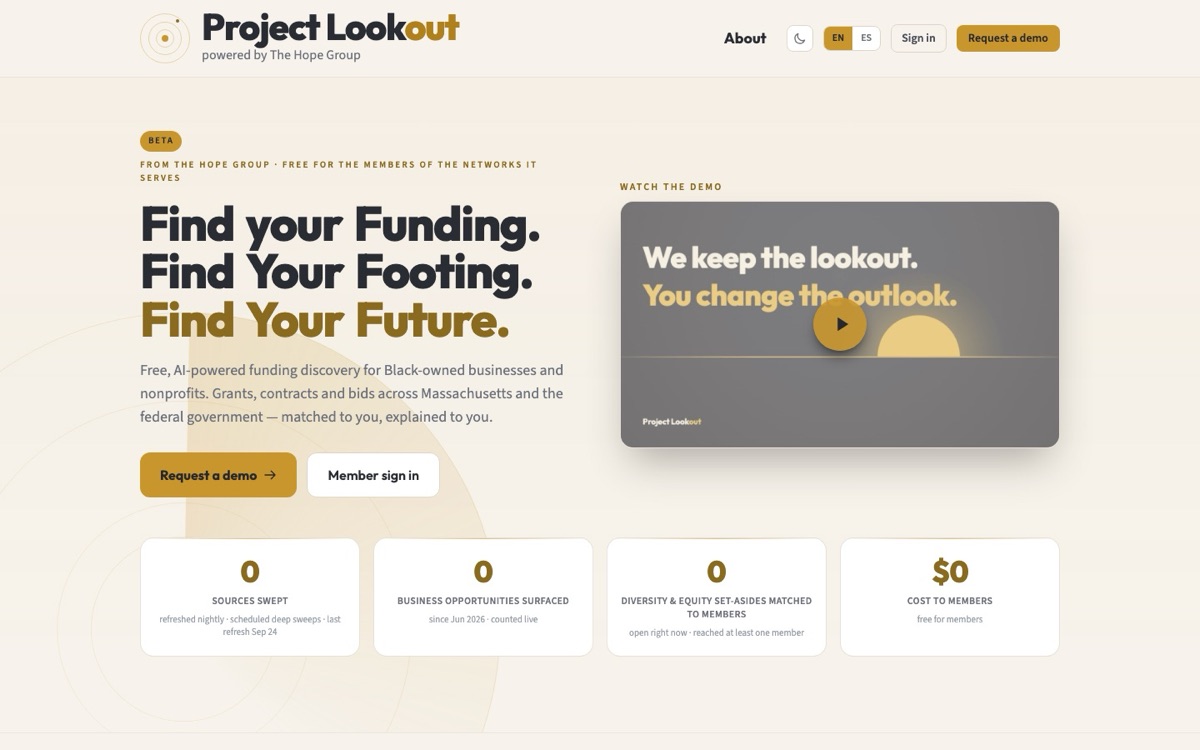
A patent pending procurement-intelligence platform that sweeps 100+ grant, contract, and bid sources every night, verifies every link, and scores each opportunity against a member's real business profile with a formula it can explain. Free for the members of the networks it serves.
Big companies win public funding because they can afford whole business-development teams to find and chase it. Every week, millions of dollars in opportunities go out across Massachusetts: RFPs, contracts, grants, preferred-vendor lists, gigs. To find them by hand you would have to run thousands of searches, many times a day, across 100+ portals, each with its own login, before breakfast, every day.
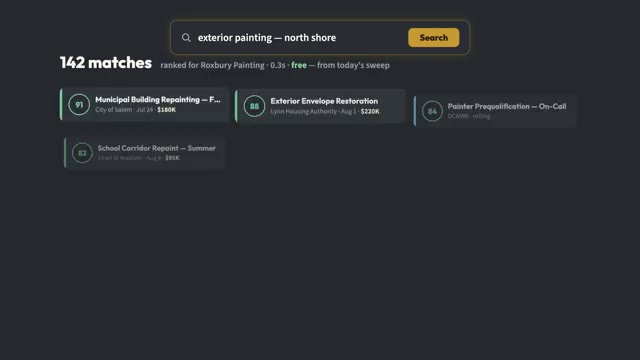
Project Lookout gives that same firepower to the underserved and underestimated Black- and Brown-owned small businesses and nonprofits who cannot afford it. It sweeps 100+ procurement, grant, and job-listing sources every night, verifies every link, reads each posting into clean facts, and scores each opportunity against a member’s real business profile with a transparent, explainable formula. The result is a personal, ranked feed where every match shows why it fits and what is missing, plus a daily email digest, plain-language search, AI tools that read complex RFPs, and a pipeline that tracks a lead from first sighting to won contract.
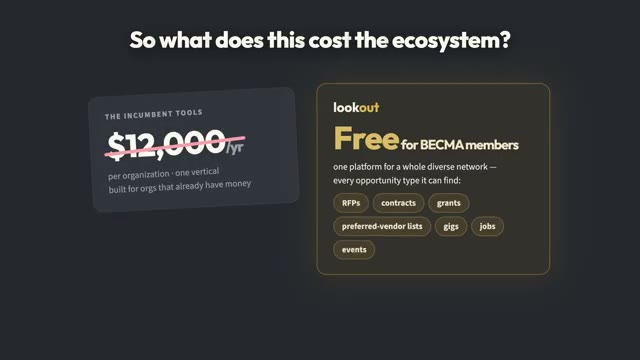
It is free for the members of the networks it serves. The tools it replaces cost around $12,000 a year per seat, and each is locked to a single lane: one for nonprofit grants, another for government procurement, another for construction bids. Lookout is one place, every lane, matched to you.
The idea that makes free possible is search once, match many. The expensive way to build this is one AI search per member, which balloons costs until you are priced like the incumbents. Lookout sweeps every source once a day into one shared, verified opportunity pool, then matches that pool against every member’s profile. AI cost scales with sources, not members. It is a fairness property too: everyone is matched against the same complete pool, ranked by the same transparent formula, with no thinner feed for joining late.
Under the hood it is a relay between code and AI with human judgment built in at every layer: humans when needed, code when convenient, AI when necessary. Stephen Walter led design, development, testing, deployment, and project management alongside Rev. Christopher Hope and Yunzi Wan, with the Black Economic Council of Massachusetts as the first network on the platform. It runs in production on Google Cloud with scheduled automation, monitoring, daily backups, and a migration-owned schema, and it was built in defined milestones, each gated by a growing test suite and adversarial code review before deploy.
Inside Project Lookout
What it looks like to use.
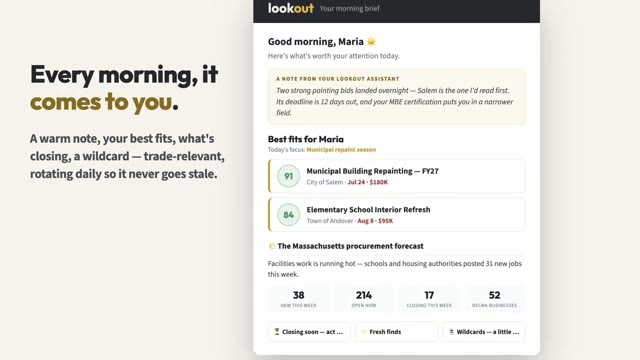
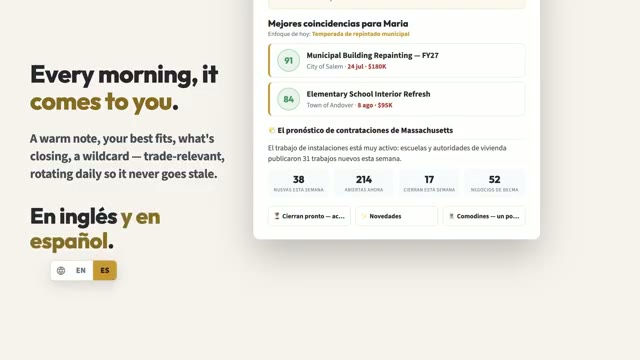
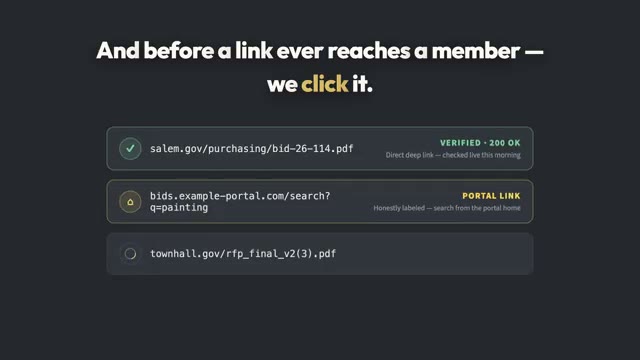
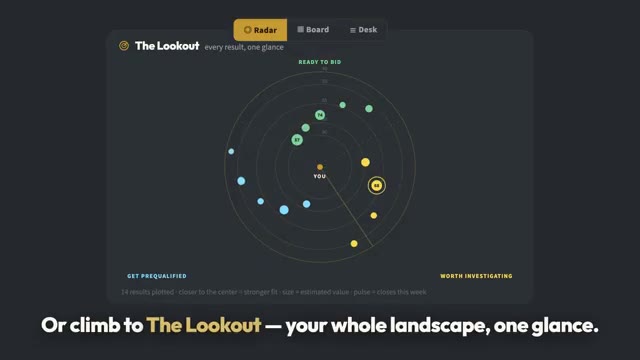
Frames from the walkthrough and screens from the running app. Watch the full demo on YouTube.
How it works
The work behind every card.
- 1
Sources
100+ Massachusetts, federal, and supplier-diversity portals, plus the open web.
- 2
Feeds and scrapes
Nightly direct pipes from SAM.gov, Grants.gov, and COMMBUYS, at no cost.
- 3
Grounded AI
A search-grounded language model hunts for what the feeds miss.
- 4
Verification
Every URL is HTTP-checked. Verified, or honestly labeled.
- 5
Extraction
AI reads each posting into facts: deadline, value, set-asides, codes.
- 6
Deterministic score
Code computes every score with versioned weights. Never a whim, never a black box.
- 7
Your feed
Ranked matches, a digest, and alerts, with the receipts attached.
What it does
Everything it does, and nothing extra.
Finds every opportunity
A deep, grounded AI sweep across 100+ procurement, grant, and job-listing sources every day, so your team does not have to run thousands of searches across portals with a design straight out of 1999.
Matches each one to you
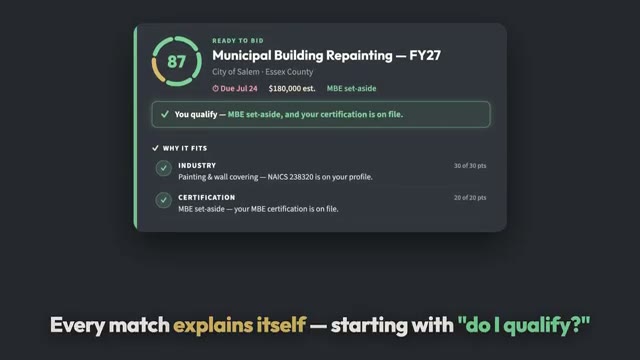
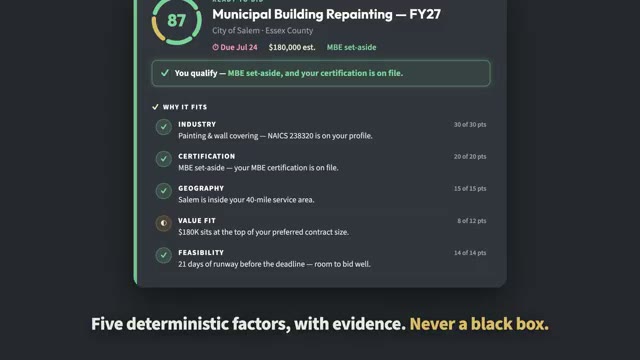
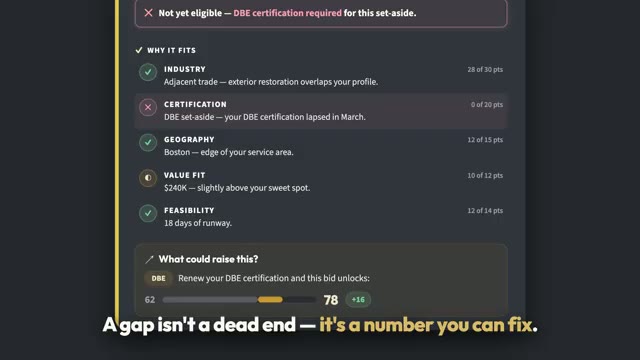
Scores every opportunity against your real business profile with a transparent five-factor formula, and shows why it fits and what is missing.
Verifies before you see it
Every link is checked and every listing is confirmed live before it reaches you. When a deep link cannot be confirmed, Lookout says so and routes you to the real portal instead of inventing one.
Reads the heavy RFPs
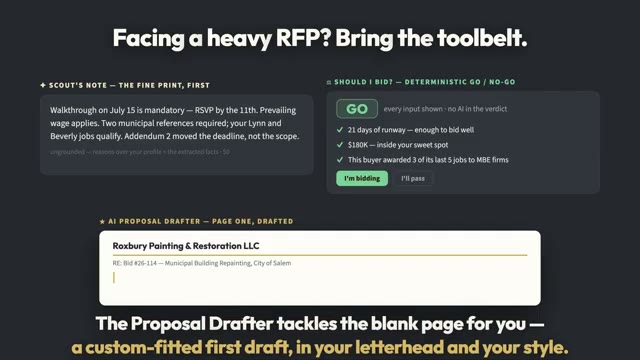
A scout that reads the fine print, a go or no-go check, and a proposal drafter that produces a custom-fitted first draft. A person reviews and decides before anything is sent.
Tracks the win
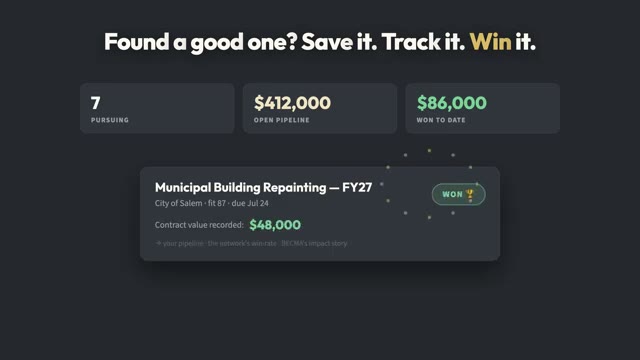
A pipeline that follows a lead from first sighting to won contract, with one tap when it ends, so the whole network's story gets told.
Search once, match many
Lookout sweeps every source once a day into one shared, verified pool, then matches that pool against every member. AI cost scales with sources, not members. That is why a whole network can use it for free, and why everyone is matched against the same complete pool by the same formula.
Design principles
The rules it was built by.
Honesty as a feature
Verified or labeled, never faked. Projections say they are estimates. Misses are shown on purpose. Trust is the product.
Plain language first
Scores explain themselves, options say what they cost, jargon gets translated. No one is left behind by acronyms.
Bilingual by default
The entire app, digest, and guided tour in English and Spanish. One toggle, full parity, not an afterthought.
Deterministic fairness
Everyone matched against the same pool by the same transparent formula. No thinner feed for joining late or clicking less.
Accessibility is required
Screen-reader announcements, keyboard-operable dialogs, measured contrast in both themes, and a tour that points rather than hijacks.
The data stays the network's
Never used to train models, never crossed between tenants, exportable any day, deletable on request, every access audit-logged.
The hard problems
What it took, and how we solved it.
The interesting engineering is invisible when it works. Open one.
TrustAI invents plausible links that do not exist
Grounded models happily generate deep URLs that look real and 404. For a tool people use to find live bids, one ghost bid destroys trust. So every candidate URL is HTTP-checked before it is ever labeled verified; when a deep link cannot be confirmed, the system says "portal link" and routes to the real portal. Enrichment can never re-promote an unverified link. The honesty is enforced in code, not hoped for.
FairnessA score you can check, not a black box
Ranking with a language model is easy and wrong: unexplainable, non-reproducible, and able to quietly encode bias against the very businesses the platform exists to serve. Scoring is fully deterministic, a five-factor formula with versioned weights, and every factor carries plain-English evidence, including misses. A standing accuracy and bias test suite gates every release: swapping a business's name never changes its score, and holding a certification can never lower one. A red run blocks delivery.
SecurityPrompt injection from the open web
The system reads untrusted text from across the web, and a malicious posting could try to talk the AI into promoting a phishing link or fabricating a set-aside. A registered portal host is the only trust signal an attacker cannot forge, untrusted text is fenced before it reaches a prompt, and fact extraction accepts only explicitly stated set-asides, codes, and values. The assistant cannot be argued into a claim the source does not literally support.
ScaleMatching a whole network without falling over
Matching a growing pool against every member, several searches at once, kept exhausting memory. The rule that emerged: never load full opportunity records at network scale. Heavy columns are deferred, queries fetch only what they need, and ranking runs through an in-memory matrix instead of per-row fetches. Search dropped from seconds to under a second.
ReliabilityOne outage should not lose a day's work
A nightly sweep runs unattended for up to 30 minutes across several instances. Cross-instance locks, orphaned-run recovery on boot, timezone-hardened deadlines, durable per-phase stats, and alerts to a real inbox mean the system fails safe and heals itself.
CraftPlain language for a jargon-heavy domain
Public procurement is a wall of acronyms, and the people who most need this tool are the least served by that jargon. Plain language is a first-class requirement: scores explain themselves, options say what they cost, and the whole app is bilingual with a warm light theme, a rich dark theme, real mobile navigation, and measured accessibility.
The Hope Standard, applied
How our values show up inside Project Lookout.
Values are easy to print. Here is where they live in the product.
Every match shows the five factors that scored it and the evidence behind each one, including the misses. If Lookout is wrong about you, you can see why and fix it.
A standing accuracy and bias suite runs before every release. Swapping a business's name never changes its score, and holding a certification can never lower one.
Public opportunities are gathered anywhere. Member profiles are never used to train models, never crossed between tenants, exportable any day, and deletable on request, with every access audit-logged.
Lookout never submits anything. It finds, ranks, and drafts. A person decides, and the pipeline records what they decided.
Designed and built with members of the Black Economic Council of Massachusetts, inspired by a collaboration with Nicole Wiggins of Jewn Enterprises, and reshaped by what members told us.

Licensing
Three ways to bring Project Lookout to your community.
Direct organizational license
For small businesses and nonprofits that want Lookout working for their own team.
Institutional distribution license
For chambers, foundations, networks, and financial institutions distributing Lookout as a member or grantee benefit. Multi-tenant from day one, so a new network onboards without a rebuild.
Build-out partnership
Custom configuration for a community, region, or funding ecosystem.
More projects
All projects Tool · Project Lookout
Every opportunity your organization deserves, found and ranked for you
A patent pending procurement-intelligence platform that sweeps 100+ grant, contract, and bid sources every night, verifies every link, and scores...
Patent pending · Launching October 6 · Free for BECMA members
Read more
Tool · Project Lookout
Every opportunity your organization deserves, found and ranked for you
A patent pending procurement-intelligence platform that sweeps 100+ grant, contract, and bid sources every night, verifies every link, and scores...
Patent pending · Launching October 6 · Free for BECMA members
Read more
 Tool · Driftwood
Software drifts. Driftwood catches it.
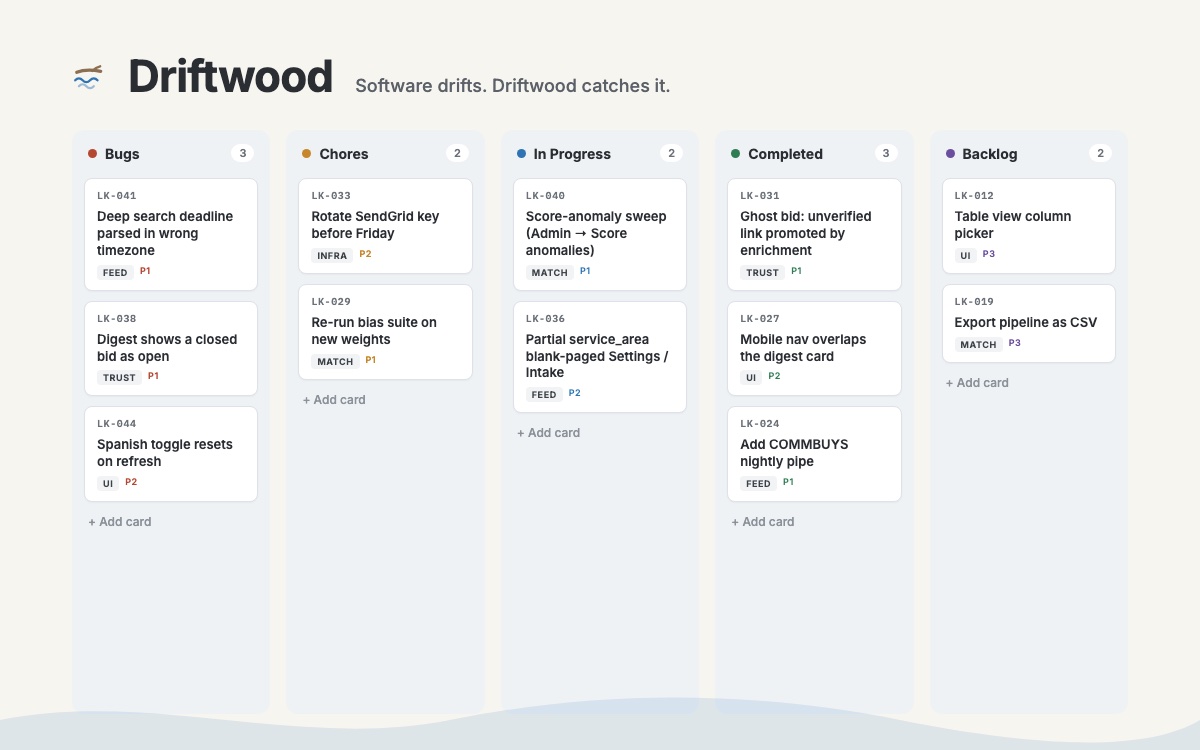
An open source design research platform for running a beta without losing the plot. A calm Stream where testers report what drifted loose, a board...
Open source · Live at cmd-z.com · Running the Lookout beta
Read more
Tool · Driftwood
Software drifts. Driftwood catches it.
An open source design research platform for running a beta without losing the plot. A calm Stream where testers report what drifted loose, a board...
Open source · Live at cmd-z.com · Running the Lookout beta
Read more
 Program · Civic AI Access Lab
Civic AI Access Lab: apprentice-delivered AI training for small business owners
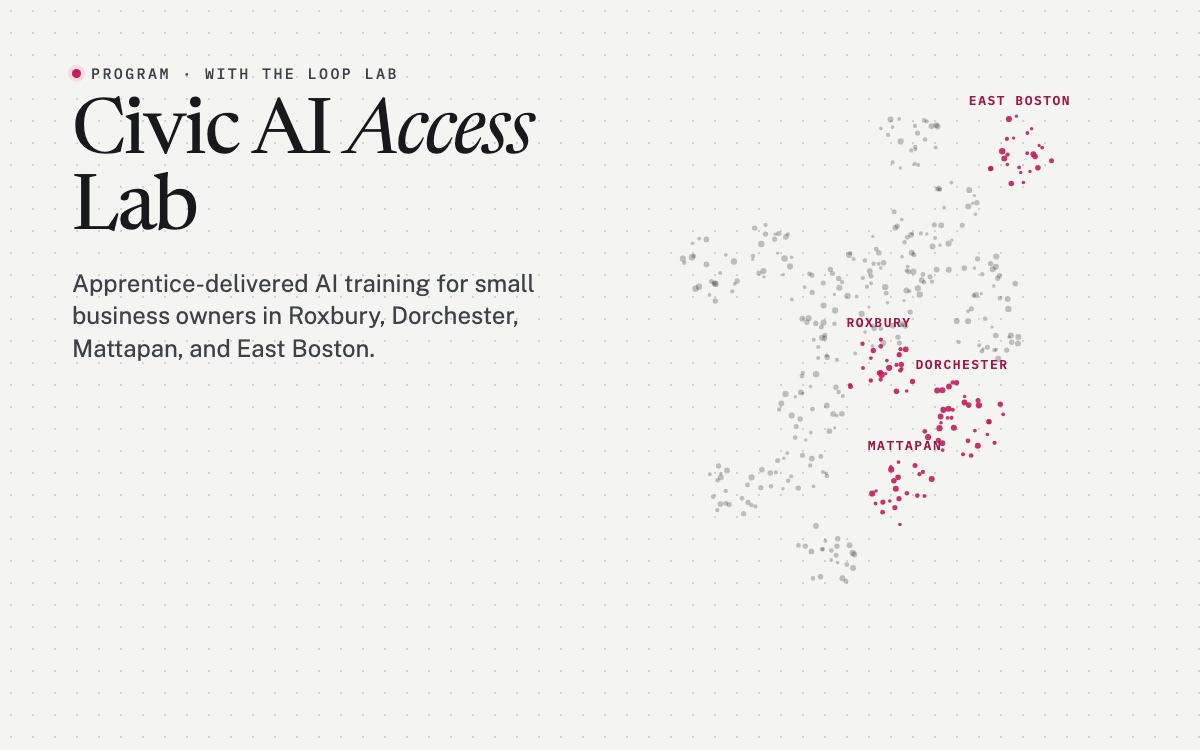
A six-month, neighborhood-based program that trains 40 to 50 small business owners in Roxbury, Dorchester, Mattapan, and East Boston to solve real...
2026 · with The Loop Lab and the City of Boston
Read more
Program · Civic AI Access Lab
Civic AI Access Lab: apprentice-delivered AI training for small business owners
A six-month, neighborhood-based program that trains 40 to 50 small business owners in Roxbury, Dorchester, Mattapan, and East Boston to solve real...
2026 · with The Loop Lab and the City of Boston
Read more